Can Agricultural and Forestry Buildings Be Built in the Green Belt?
Discover the rules for replacing buildings in the Green Belt, including size limits, same use requirements, key court decisions, and common planning pitfalls.
GREEN BELT
Andrew Ransome
8/27/20266 min read
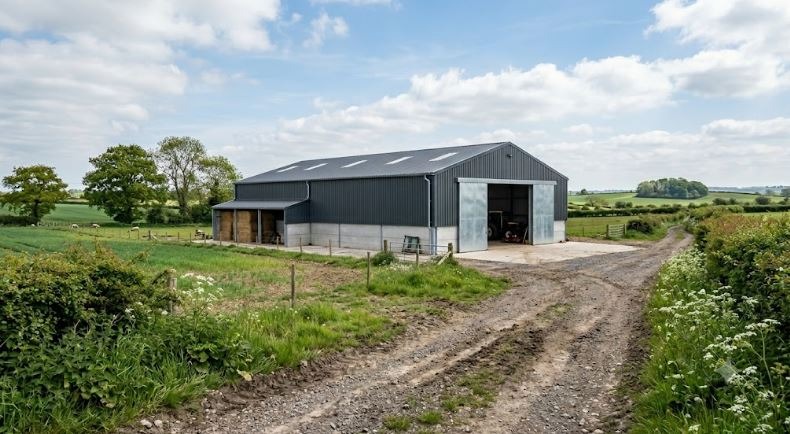
The short answer is that buildings genuinely for agriculture or forestry are not inappropriate development in the Green Belt.
This is one of the most permissive exceptions in the entire paragraph 154 framework, and it is deliberately so: the Green Belt has always been understood as compatible with productive agricultural and forestry use.
The key question in every case is simply whether the building is genuinely for agriculture or forestry.
This article explains the policy exception, how it operates in practice, its relationship with permitted development rights, and the important distinction between agricultural buildings.
Green Belt Policy: Policy GB7(1)(a)
Policy GB7(1)(a) of the National Planning Policy Framework published in August 2026 provides that development which is for agriculture, horticulture and forestry — or which is solely for nature conservation, restoration or enhancement — is not inappropriate development in the Green Belt.
This is a slightly broader formulation than the equivalent provision under the previous NPPF, which referred only to "buildings for agriculture and forestry."
Two changes are worth noting.
First, the current wording refers to "development" rather than "buildings," which on its face is not limited to built structures.
Second, horticulture is now expressly named alongside agriculture and forestry, and a separate limb covering development solely for nature conservation, restoration or enhancement now sits within the same sub-paragraph.
For the purposes of agricultural and forestry buildings specifically, the practical effect is unchanged. It carries no size limit, no proportionality threshold, and no requirement to assess the effect on the openness of the Green Belt.
If the proposed building is genuinely for agriculture, horticulture or forestry, it is not inappropriate — regardless of its scale, footprint or bulk.
This broad permissiveness reflects the longstanding policy position that agriculture and forestry are among the most traditional and compatible land uses in the Green Belt.
The physical infrastructure needed to support them — livestock buildings, grain stores, machinery sheds, timber storage buildings — is simply a necessary part of productive rural land management.
A large agricultural building is treated differently from a large residential or commercial building, not because of any difference in its physical impact on openness, but because of its purpose and its fundamental compatibility with the character and function of Green Belt land.
The High Court in Europa Oil and Gas Limited v Secretary of State for Communities and Local Government [2013] confirmed a principle of wider importance to the Green Belt exceptions framework as a whole. The impact of a development on openness is not necessarily related to its size, but also to its purpose.
Policy GB7(1)(a) does not have an openness-related test attached to it at all, in contrast to other categories such as outdoor sport and recreation facilities under policy GB7(1)(f), which are not inappropriate only where the impact on openness is minimised.
What Does 'For Agriculture, Horticulture or Forestry' Mean?
The NPPF does not define agriculture, horticulture or forestry for these purposes.
The most relevant definition for planning purposes is that in section 336 of the Town and Country Planning Act 1990, which defines agriculture broadly to include horticulture, fruit growing, seed growing, dairy farming, the breeding and keeping of livestock, the use of land as grazing land, meadow land, osier land, market gardens and nursery grounds, and the use of land for woodlands where that use is ancillary to the farming of land for other agricultural purposes.
In practice, the purpose of a proposed building will usually be apparent from the application description, the accompanying agricultural appraisal or agent's statement, and the existing use of the land.
Decision-makers are to determine applications as submitted, unless the evidence firmly indicates that the proposed building would not genuinely be for agriculture, horticulture or forestry.
Planning Permission vs Permitted Development Rights
Many agricultural buildings do not require a planning application at all.
Class A and Class B of Part 6 of the Town and Country Planning (General Permitted Development) (England) Order 2015 (GPDO) grant permitted development rights for certain agricultural buildings and works on agricultural units of 5 hectares or more (Class A) or between 0.5 and 5 hectares (Class B), subject to size limits, prior approval requirements and exclusion categories.
The permitted development test is whether a building is reasonably necessary for the purposes of agriculture within the agricultural unit.
It applies only to the exercise of PD rights.
When an applicant makes a full planning application for an agricultural building in the Green Belt, the policy GB7(1)(a) exception applies, and no equivalent 'reasonably necessary' test exists.
This is an important distinction. A building that might not satisfy the PD test (because, for example, it exceeds the size thresholds or the agricultural unit is too small to trigger Class A rights) may nonetheless be entirely acceptable under policy GB7(1)(a) if a full planning application is made.
Applicants considering agricultural buildings in the Green Belt should always check whether the PD route is available before investing in a full planning application.
Where PD rights are available and the proposed building falls within the permitted parameters, the prior approval route may be simpler, cheaper and faster.
Where PD rights are not available — for example, because the unit is below the minimum size threshold, or the building exceeds the Class A or B dimensional limits — a full application under policy GB7(1)(a) remains available.
Prior Approval and the Green Belt
Where a planning application is required rather than prior approval, the assessment is straightforward under policy GB7(1)(a) — the building is not inappropriate provided it is for agriculture, horticulture or forestry.
However, where prior approval is sought under Part 6 of the GPDO, the prior approval assessment is limited to specific matters:
the siting, design and external appearance of the building; the impact on the amenity of any adjoining properties; and any other matters specified in the relevant Class.
Green Belt policy does not form part of the prior approval assessment for Part 6 agricultural buildings.
This is because PD rights operate by granting planning permission automatically, and the conditions attached to those rights define the scope of the assessment.
Rural Workers' Dwellings: A Separate Question
A dwelling for an agricultural or forestry worker is not development for agriculture, horticulture or forestry within the meaning of policy GB7(1)(a), even where it is essential to support the agricultural operation.
Its primary use is residential, not agricultural.
This distinction has been consistently upheld in appeal decisions.
Unless a rural worker's dwelling falls within another exception in policy GB7 — it is inappropriate development in the Green Belt.
Planning permission can only be granted if the applicant demonstrates very special circumstances under policy GB6 that clearly outweigh the harm to the Green Belt by reason of inappropriateness and any other harm.
The primary other consideration typically advanced in support of a rural worker's dwelling is the essential need for the worker to be on or immediately adjacent to the agricultural unit — the same essential-need test now also reflected in policy HO11(1)(a), which governs isolated homes in the countryside more generally.
The need must be genuine and current. A speculative or anticipated future need, or a need that could be met by accommodation elsewhere in the vicinity, will not usually constitute very special circumstances.
Conditions Commonly Attached to Agricultural Building Permissions
Where planning permission is granted for an agricultural building under policy GB7(1)(a), local planning authorities frequently seek to attach conditions to control the future use of the building.
Common conditions include:
A restriction limiting the use of the building to agriculture or forestry, preventing subsequent conversion to residential or commercial use without a further planning application.
A requirement for the building to be removed and the land restored to its former condition if the agricultural use ceases, particularly for more marginal or temporary agricultural uses.
Controls on materials and external appearance to ensure the building reads as an agricultural structure and does not visually dominate the landscape.
Limitations on external lighting, surfacing and associated infrastructure to minimise the impact on the rural character of the site.
These conditions are generally regarded as reasonable and necessary in the Green Belt context.
Agricultural and Forestry Buildings in the Green Belt: Summary
Development for agriculture, horticulture and forestry is not inappropriate development in the Green Belt under policy GB7(1)(a) of the August 2026 NPPF, regardless of its size.
The test is purpose alone: is the development genuinely for agriculture, horticulture or forestry?
No openness test, no proportionality threshold and no size limit applies — the only category of built development in policy GB7 with no openness-related test of any kind attached to it.
The planning application route under policy GB7(1)(a) is available independently of the permitted development route under Part 6 of the GPDO.
Rural workers' dwellings are not development for agriculture, horticulture or forestry and are inappropriate development requiring very special circumstances under policy GB6.
Planning Application Advice
If you own land or a building in the Green Belt and want to understand your development options, I can advise on planning strategy and manage your application from initial assessment through to decision. Contact me to discuss your site.
Andrew Ransome MRTPI - Email: andrew@andrewransome.co.uk
About me
Andrew Ransome is a Planning Director and a Chartered Member of the Royal Town Planning Institute (RTPI), with more than two decades of experience in town planning.
He specialises in delivering strategic planning solutions for complex developments across both rural and urban environments, helping clients navigate planning challenges and unlock development opportunities. Connect with Andrew on Linkedin.


Green Belt Information
Green Belt Approvals


Get in Touch
Email: andrew@andrewransome.co.uk
Tel: 020 7096 8045
London Office:
60 Tottenham Court Road
Fitzrovia
London
W1T 2EW
© 2026 Andrew Ransome Town Planning Ltd. All rights reserved.
Content on this website is provided for general information and educational purposes only and does not constitute formal planning, professional, or legal advice. Planning policies, legislation, and guidance are subject to change. Site-specific assessment by a qualified consultant is recommended before making development decisions.
Projects highlighted across this website represent professional work undertaken by Andrew Ransome throughout his career.