Can You Extend Your Home in the Green Belt?
Can you extend your home in the Green Belt? Yes—but only if it isn't a disproportionate addition to the original building. Learn the key planning rules and case law.
GREEN BELT
Andrew Ransome
8/26/20268 min read
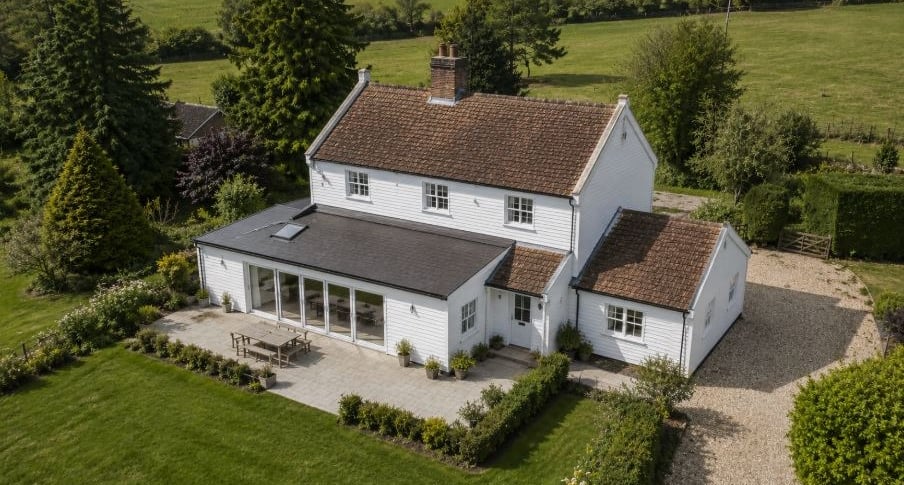
Can You Extend Your Home in the Green Belt? Yes, but home extensions in the Green Belt are not automatically allowed.
Under policy GB7(1)(b) of the National Planning Policy Framework published in August 2026, an extension to an existing dwelling is not inappropriate development provided it does not result in a disproportionate increase in size compared to the original building.
In practice, the key question is not whether you can extend your home, but whether the cumulative size of the proposed and existing additions is proportionate when compared with the original building.
For Green Belt homeowners, the desire to extend an existing dwelling is one of the most common planning questions. This article explains how the disproportionate additions test works, how the original building is identified, what recent case law says about replacement dwellings and detached outbuildings, and how permitted development rights can affect the planning assessment.
The Green Belt Policy Test: Policy GB7(1)(b)
Policy GB7(1)(b) of the August 2026 NPPF states that the extension or alteration of a building is not inappropriate development in the Green Belt, provided it does not result in a disproportionate increase in size compared to the original building.
This provision has been restructured under the current NPPF. Extension and alteration are now addressed within the same sub-paragraph as the reuse and replacement of existing buildings, rather than as separate exceptions.
For extensions specifically, however, the substantive test itself is unchanged: it remains a comparison of the proposed additions against the size of the original building.
An extension that is not inappropriate means the development does not need to be justified by very special circumstances under policy GB6 — the highest policy test in the Green Belt framework.
It remains subject to all other planning policies, including design, landscape impact and residential amenity, but it is not treated as inherently harmful to the Green Belt.
The test is therefore straightforward in structure:
compare the proposed additions (including any previously made) with the original building.
If the additions are not disproportionate, the extension is not inappropriate.
But both elements of that comparison — what is the original building, and what is disproportionate — require careful examination.
What Is the Original Building?
The NPPF's Annex B Glossary defines the original building, for this purpose, as the building as it existed on 1 July 1948 or, if constructed after 1 July 1948, as it was built originally.
The implications of this definition are significant.
For buildings that existed before 1 July 1948, the baseline is the building as it stood on that date, including any extensions added before then.
For buildings constructed after 1 July 1948, the baseline is the building as it was first built — not as it subsequently evolved through additions and alterations.
This means that every extension added to a post-1948 dwelling after it was first built forms part of the cumulative additions, regardless of whether those extensions were built under planning permission, under permitted development rights, or without any specific consent at the time.
The Guildford Judgment [2023]
The importance of the correct baseline was confirmed and reinforced by the High Court in Guildford Borough Council v Secretary of State for Levelling Up, Housing and Communities and Mr C Weeks [2023].
In that case, a Planning Inspector had assessed the proportionality of proposed extensions by reference to a replacement dwelling that had been erected on the site, treating that replacement dwelling as the new baseline.
The court confirmed that the correct baseline is the original building as first built — or, for pre-1948 buildings, as it existed on 1 July 1948. A replacement dwelling does not reset the clock.
The original building for proportionality purposes remains the first building on the site, and all subsequent development — whether extensions to that building or a replacement of it — must be assessed against that original.
The logic, as the court explained, is precisely to prevent cumulative development from inflating the effective baseline over successive rounds of extension or replacement.
The High Court quashed the decision.
This reasoning continues to apply directly under the current Framework: the definition of the original building in Annex B is unchanged, and nothing in the restructuring of policy GB7(1)(b) disturbs the Guildford analysis.
Practical consequence: where a site has seen previous extensions — or where an earlier owner built a replacement dwelling — the cumulative history must be researched before any new extension proposal is drawn up. The size of the original building as first constructed is the correct comparator, not the building as it stands today.
What Counts as Disproportionate?
The NPPF does not define disproportionate numerically, and neither the courts nor the Planning Inspectorate have established a fixed percentage threshold above which additions automatically become disproportionate.
Many local planning authorities adopt their own indicative thresholds — for example, limiting extensions to no more than 10–30% above the original building's volume — often set out in supplementary planning documents or local plan policies.
Generally, the assessment is one of planning judgement in each case, by reference to the overall size of the additions compared to the original building.
The assessment should look at overall size in terms of volume and external dimensions, as well as floorspace.
A two-dimensional floorspace comparison alone will not suffice where the proposed extension also involves a change in height, roof form or projection that adds significantly to the bulk of the building.
What the Test Does Not Involve
The disproportionate addition test does not involve an assessment of the visual impact of the extension or its effect on the openness of the Green Belt.
These are separate planning considerations, assessed under character and appearance and design policies.
The Green Belt proportionality assessment is a size comparison only — comparing the volume and external dimensions of the proposed additions (cumulative) against the original building.
An extension can therefore be proportionate in size terms and still be refused on character and design grounds if it harms the appearance of the building or its setting.
Conversely, a visually sensitive scheme that is nonetheless disproportionate in size terms could fail the policy GB7(1)(b) test regardless of its design quality.
The two assessments run in parallel, not in sequence.
Detached Structures: Can a Separate Building Count as an Extension?
It was often widely assumed that an extension under the previous, equivalent policy had to be physically attached to the main building. The High Court in Warwick District Council v Secretary of State for Levelling Up, Housing and Communities [2022] held otherwise.
In Warwick, the proposed development was a detached garden room and home office located approximately 20 metres from the principal cottage.
The Council argued this could not be an extension because it was not attached.
The court rejected that argument. It held that the extension exception is not confined to physically attached structures and that a detached structure can constitute an extension of the main building, provided there is a sufficient functional and spatial relationship between the two.
The relevant factors identified by the court include:
the proposed use of the structure;
its position relative to the main building; its size; and the degree to which it is functionally connected to the occupation of the main building.
A garden room used as ancillary domestic accommodation, a detached garage integral to the domestic use of the property, or a pool house functionally serving the main dwelling could all potentially qualify as extensions for the purposes of policy GB7(1)(b).
Warwick was decided under the previous wording of this exception, but there is nothing in the restructuring of GB7(1)(b) under the August 2026 NPPF that disturbs its reasoning, and it remains directly applicable to detached structures assessed against the current policy.
Where such structures are not permitted development, detached outbuildings, garden rooms, garages and similar ancillary structures can be assessed as extensions under policy GB7(1)(b) rather than being treated as new buildings.
However, the disproportionate addition test still applies cumulatively: the volume of any detached structure found to be an extension must be counted alongside all previous extensions against the original building baseline.
Permitted Development Rights and Extensions
Green Belt properties frequently retain householder permitted development (PD) rights under the Town and Country Planning (General Permitted Development) (England) Order 2015.
It is imporant to check that permitted development rights are still in place.
Where PD rights apply, certain works — including rear extensions, loft conversions, outbuildings and dormer windows, within specified size limits — can be carried out without a planning application.
An increasingly important consideration is the availability of permitted development rights under the larger home extension prior approval procedure and the upward extension rights introduced by Class AA of Part 1 to the Town and Country Planning (General Permitted Development) (England) Order 2015.
Subject to the relevant limitations and conditions, homeowners may be able to construct substantial single-storey rear extensions through the prior approval process or add additional storeys to certain detached houses under Class AA without obtaining express planning permission.
Often, larger extensions may be possible under permitted development compared with a planning application.
The Fallback Position
A common and legitimate planning strategy is to rely on PD rights as a fallback argument in support of a planning application for a larger or differently designed extension scheme.
The argument runs: if permission is refused for the proposed scheme, the PD fallback will be implemented instead, and that fallback may have a larger aggregate impact on the Green Belt or a less coherent design than the proposed scheme.
In Mansell v Tonbridge and Malling Borough Council [2017], the Court of Appeal confirmed that permitted development rights can legitimately constitute a fallback position that is a material consideration in the Green Belt balance, now applied within the very special circumstances test under policy GB6.
It is important to be clear, however, that the existence of PD rights does not adjust the original building baseline for the disproportionate addition test.
Where PD rights are relied upon as a fallback, the strongest evidential position is to obtain a Certificate of Lawful Development (Proposed) under section 192 of the Town and Country Planning Act 1990 before submitting the main application.
This confirms the legality of the fallback beyond dispute, making it harder for the local planning authority to argue that the fallback is not genuinely available.
Cumulative Extensions: Getting the Evidence Right
Because the test is cumulative, an applicant must be able to demonstrate the size of the original building accurately before the proportionality assessment can be properly carried out. This typically requires:
A careful review of planning history on the local authority's register to identify all previous permissions and any prior approvals relating to extensions or alterations.
A check on historic Ordnance Survey maps to establish the approximate footprint and scale of the building when first constructed or as at 1 July 1948.
Dimensional surveys of the existing building and any previous extensions where the history is unclear or disputed.
A clear schedule in the design and access statement or planning statement setting out the original building dimensions, all previous additions, the proposed additions, and the cumulative total.
Where this evidence is incomplete or contested, the risk of a disproportionality finding is significantly higher.
Planning Inspectors and planning officers will not simply accept an applicant's assertion that the proposed extension is proportionate — they will want to see the calculations.
Green Belt Building Extensions - Summary
Extending a building in the Green Belt is not inappropriate development under policy GB7(1)(b) of the August 2026 NPPF, provided the extension does not result in a disproportionate increase in size compared to the original building.
The original building is defined by reference to the building as first built (post-1948) or as it stood on 1 July 1948 (pre-1948): it is not the building as it currently stands.
The Guildford [2023] judgment confirms that replacement buildings do not reset the baseline.
Disproportionality is assessed by reference to overall size — volume, external dimensions and floorspace — not by visual impact or effect on openness.
Following Warwick [2022], detached outbuildings can constitute extensions provided they are functionally and spatially connected to the main building.
Permitted development rights can be a material fallback consideration but do not adjust the original building baseline.
Getting the evidence base right from the outset is essential.
Planning Application Advice
If you own land or a building in the Green Belt and want to understand your development options, I can advise on planning strategy and manage your application from initial assessment through to decision. Contact me to discuss your site.
Andrew Ransome MRTPI - Email: andrew@andrewransome.co.uk
About me
Andrew Ransome is a Planning Director and a Chartered Member of the Royal Town Planning Institute (RTPI), with more than two decades of experience in town planning.
He specialises in delivering strategic planning solutions for complex developments across both rural and urban environments, helping clients navigate planning challenges and unlock development opportunities. Connect with Andrew on Linkedin.


Green Belt Information
Green Belt Approvals


Get in Touch
Email: andrew@andrewransome.co.uk
Tel: 020 7096 8045
London Office:
60 Tottenham Court Road
Fitzrovia
London
W1T 2EW
© 2026 Andrew Ransome Town Planning Ltd. All rights reserved.
Content on this website is provided for general information and educational purposes only and does not constitute formal planning, professional, or legal advice. Planning policies, legislation, and guidance are subject to change. Site-specific assessment by a qualified consultant is recommended before making development decisions.
Projects highlighted across this website represent professional work undertaken by Andrew Ransome throughout his career.