Planning Permission for the Conversion of Buildings in the Green Belt
Thinking of converting a barn or other building in the Green Belt? Learn how re-use and conversion proposals can qualify as exceptions to inappropriate development.
GREEN BELT
Andrew Ransome
8/26/20265 min read
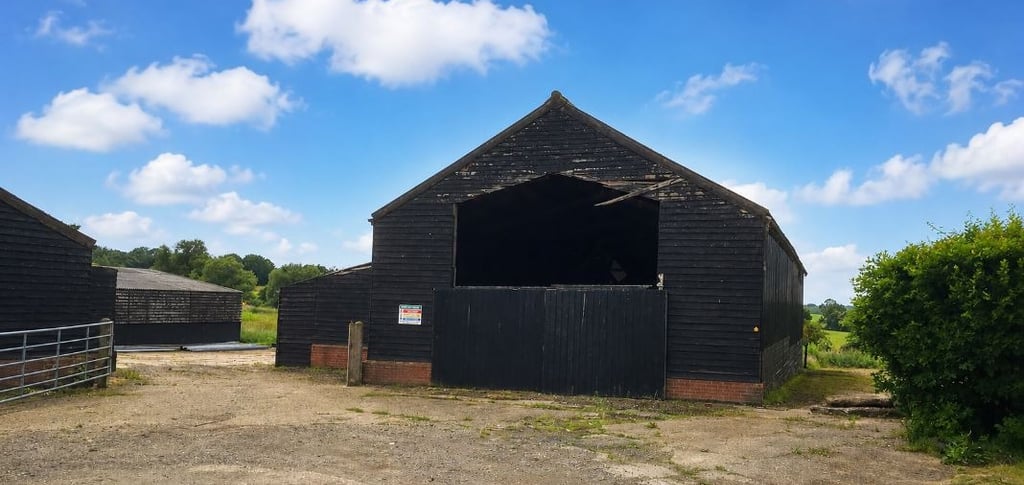
The conversion and re-use of existing buildings is one of the most commercially significant exceptions to inappropriate development in the Green Belt.
For owners of redundant buildings in the Green Belt, it can provide a route to new residential, leisure or commercial uses without the need to demonstrate very special circumstances.
The National Planning Policy Framework published in August 2026 has restructured Green Belt policy into a codified set of policies, GB1 to GB8, and has made a change to this exception that is more than a simple renumbering exercise.
This article sets out the current tests and their practical implications for projects involving the conversion and re-use of existing buildings in the Green Belt.
NPPF: Policy GB7(1)(b)
Under the previous NPPF, the re-use of buildings, the extension or alteration of buildings, and the replacement of buildings were each addressed as separate exceptions, with re-use carrying its own express openness test.
The August 2026 NPPF has consolidated all four of these — reuse, extension, alteration and replacement — into a single provision, policy GB7(1)(b):
The reuse, extension, alteration or replacement of an existing building, provided that the existing building is of permanent and substantial construction, is lawful in planning terms, and any extension or alteration will not result in a disproportionate increase in size compared to the original building. In the case of proposals for a replacement building, it should be for the same use and not materially larger than the one it replaces.
This is an altered structure from the previous NPPF, and it changes what actually has to be demonstrated depending on which type of proposal is being brought forward.
A Significant Change: The Openness Test for Straightforward Re-use
Under the previous NPPF, a straightforward change of use of an existing building — with no extension, alteration or rebuild — had to satisfy the following conditions:
that the building was of permanent and substantial construction; and
that the development preserved the openness of the Green Belt.
Policy GB7(1)(b) of the August 2026 NPPF only requires that the existing building is of permanent and substantial construction and is lawful in planning terms.
The "disproportionate increase in size" test is expressly scoped to "any extension or alteration," and the "not materially larger" test is expressly scoped to replacement buildings.
Reuse — meaning a genuine change of use with no extension, alteration or rebuild — is not expressly made subject to either test.
The critical change is that there is no lomger any separate express requirement to demonstrate that the change of use itself preserves the openness of the Green Belt.
This is a genuinely significant liberalisation for barn conversions and similar re-use schemes that do not involve physical extension, but where matters like domestic paraphernalia have been judged in the past to affect Green Belt openness.
Permanent and Substantial Construction
This requirement is unchanged in substance and continues to apply to reuse, extension, alteration and replacement alike.
It filters out temporary, lightweight or structurally degraded buildings not capable of genuine conversion without essentially being rebuilt.
A timber-framed polytunnel, a heavily deteriorated structure with no meaningful remaining fabric, or a prefabricated temporary building will not satisfy this test.
Applicants are often expected to demonstrate — typically through a structural survey — that the building could be converted rather than demolished and rebuilt.
The Openness Case Law: Still Relevant Context
The case law developed under the previous "preserves openness" test for residential re-use remains useful background, even though it no longer operates as an express gateway condition for straightforward reuse.
In Smith v Secretary of State for Communities and Local Government [2017], the High Court confirmed there was no legal error in an Inspector finding that proposed fencing, bin storage, car parking and domestic paraphernalia associated with a residential conversion would fail to preserve openness.
In Baynham v Secretary of State for Communities and Local Government and East Hertfordshire District Council [2017], the judge endorsed an Inspector's approach to openness in the context of residential re-use — the question being whether the character of the use introduced is urban in nature and whether that harms openness.
This reasoning remains directly relevant wherever openness is still an express test — for example, under policy GB7(1)(e) for previously developed land, or under policy GB6 where a proposal is found to be inappropriate and falls to be assessed against very special circumstances.
It also remains relevant where a proposal is not a straightforward re-use at all e.g. where domestic paraphernalia and associated works are so extensive that the proposal is better characterised as new development, rather than genuine re-use of, the existing building and require very special circumstances under policy GB6 — at which point openness, including the accumulation of domestic features identified in Smith and Baynham, becomes directly relevant again as part of the harm to be weighed.
Extensions Alongside Re-use
Where a proposal involves re-use together with extensions or alterations, the extension or alteration element must still satisfy the disproportionate-increase test within policy GB7(1)(b).
The extension must not result in a disproportionate increase in size compared with the original building — meaning the building as it existed on 1 July 1948, or as it was originally built if constructed after that date.
A modest re-use of a barn together with a small extension therefore still needs to satisfy the proportionality test for the extension element, even though the reuse element itself no longer carries an express openness test.
Both elements sit within the same sub-paragraph, but the tests that apply to each remain distinct.
Class Q and the Re-use Exception
Agricultural buildings can in many cases be converted to residential use under Class Q of the GPDO, subject to prior approval.
Class Q rights do not engage Green Belt policy directly — permitted development operates by granting planning permission automatically without a Green Belt assessment, and this mechanism is unaffected by the NPPF restructuring.
The relationship between Class Q and the re-use exception becomes relevant where an applicant seeks full planning permission for a conversion going beyond what Class Q would permit, using the Class Q prior approval as a fallback position.
Where a full application is pursued instead of, or alongside, Class Q, it is policy GB7(1)(b) — rather than the GPDO — that determines whether the conversion itself is not inappropriate development.
Re-use and Conversion of Buildings in the Green Belt: Summary
The re-use, extension, alteration and replacement of permanent and substantial existing buildings are now addressed together under policy GB7(1)(b) of the August 2026 NPPF.
The most significant change is that straightforward reuse — a change of use with no extension, alteration or rebuild — is no longer subject to an express test requiring the proposal to preserve the openness of the Green Belt or avoid conflict with Green Belt purposes.
Only permanent-and-substantial-construction and lawfulness need to be demonstrated for reuse itself.
Extensions and alterations continue to be tested against the disproportionate-increase-in-size standard, measured against the 1948 original building, and replacement buildings continue to be tested against the not-materially-larger standard.
The established case law on openness and residential re-use remains relevant wherever openness is still an express test elsewhere in the NPPF, and where a proposal goes beyond genuine re-use.
Planning Application Advice
If you own land or a building in the Green Belt and want to understand your development options, I can advise on planning strategy and manage your application from initial assessment through to decision. Contact me to discuss your site.
Andrew Ransome MRTPI - Email: andrew@andrewransome.co.uk
About me
Andrew Ransome is a Planning Director and a Chartered Member of the Royal Town Planning Institute (RTPI), with more than two decades of experience in town planning.
He specialises in delivering strategic planning solutions for complex developments across both rural and urban environments, helping clients navigate planning challenges and unlock development opportunities. Connect with Andrew on Linkedin.


Green Belt Information
Green Belt Approvals


Get in Touch
Email: andrew@andrewransome.co.uk
Tel: 020 7096 8045
London Office:
60 Tottenham Court Road
Fitzrovia
London
W1T 2EW
© 2026 Andrew Ransome Town Planning Ltd. All rights reserved.
Content on this website is provided for general information and educational purposes only and does not constitute formal planning, professional, or legal advice. Planning policies, legislation, and guidance are subject to change. Site-specific assessment by a qualified consultant is recommended before making development decisions.
Projects highlighted across this website represent professional work undertaken by Andrew Ransome throughout his career.