Presumption in Favour of Sustainable Development in Planning Decisions
How the presumption in favour of sustainable development works under the August 2026 NPPF: policies S3 to S6, development inside and outside settlements, and what it means for your site.
PLANNING POLICYPLANNING APPLICATIONS
Andrew Ransome
11/7/20267 min read

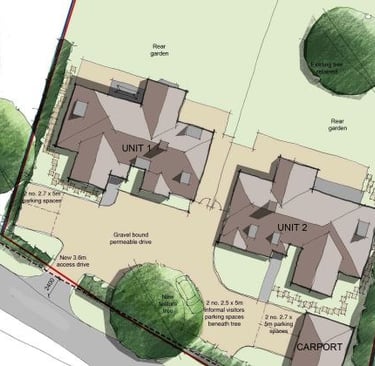
The presumption in favour of sustainable development has been at the heart of national planning policy since 2012.
For most of that time it worked as a fallback. If a council's local plan was out of date, or it could not show a five-year housing land supply, the "tilted balance" applied and permission should be granted unless the harm significantly and demonstrably outweighed the benefits.
The August 2026 National Planning Policy Framework (NPPF) rebuilt the presumption.
It no longer depends on whether a plan is out of date. Instead it is permanent, and it depends on location: whether a site is inside or outside a settlement.
For homeowners, landowners and developers, this is the most important change in the new Framework. It applies to every planning decision made since 17 August 2026.
This guide explains how policies S3 to S6 work and what they mean for your site.
Policy S3: The Starting Point
Policy S3 sets out the presumption and directs decision-makers to the right test:
Within settlements, policy S4 applies
Outside settlements, policy S5 applies
In all locations, proposals that accord with both an up-to-date development plan and the national decision-making policies should be approved without delay
Where a site lies partly inside and partly outside a settlement, S3(2) requires S4 and S5 to be applied to the relevant parts before reaching an overall view. This is a common situation for sites on the edge of a village.
What Counts as a "Settlement"?
Because everything turns on location, the definition of a settlement is critical.
The NPPF glossary says settlements include cities, towns, villages and other predominantly built-up areas. They also include land which is allocated or has permission for development that will form part of the built-up area once complete. Areas defined as settlements in the development plan also count, whether through settlement boundaries or criteria-based policies.
Two exclusions are important:
Hamlets and scattered groups of houses outside predominantly built-up areas are not settlements, unless the development plan specifically defines them as such
Villages washed over by the Green Belt are excluded from the definition for the purposes of the NPPF
Note that land with planning permission, or allocated for development, counts as part of the settlement.
Policy S4: Development Within Settlements
Inside settlements, the NPPF is strongly supportive.
Policy S4 says development proposals should be approved unless the benefits would be substantially outweighed by any adverse effects, assessed against the national decision-making policies.
That is a higher bar for refusal than the old tilted balance, which required harm to "significantly and demonstrably" outweigh benefits. It now applies to all development within settlements, whether or not the council has a five-year housing land supply.
Policy S4(2) gives examples of when the benefits are likely to be substantially outweighed. These include proposals that would:
have a substantial adverse impact on land allocated or safeguarded for other uses in the development plan
have a substantial adverse impact under national policies on existing recreational land, Local Green Space, important biodiversity sites, Protected Landscapes, or development within residential curtilages
result in the loss of undeveloped land used as a cemetery, or for water storage or flood risk management, without suitable compensation
fail one of the national policies that say development should be refused in specific circumstances
For homeowners and small developers, S4 gives strong support to infill plots, garden land, subdivisions and small redevelopment schemes within settlements. Design, amenity and the specific policy on residential curtilages still need to be addressed.
My guide to building in your garden and infill plots explains the practical issues.
Policy S5: Development Outside Settlements
Outside settlements, the approach is different.
Policy S5 says only certain forms of development should be approved, and sets them out in a list.
Development that falls within the list should be approved unless the benefits would be substantially outweighed by adverse effects.
The categories include:
(a) agriculture, forestry, outdoor sport and recreation, infrastructure and similar uses
(b) rural businesses and services, including tourism, where a location outside settlements is shown to be necessary
(c) the reuse, extension, alteration or replacement of existing permanent buildings, where extensions are not disproportionate and replacements are for the same use and not disproportionately larger
(d) the redevelopment of previously developed land, including changes of use to residential
(e) limited infilling within groups of houses
(f) rural exception sites and community-led development
(g) traveller sites meeting an evidenced unmet need
(h) residential and mixed-use development within reasonable walking distance (around 800 metres) of a well-connected station
(i) land allocated for that purpose in the development plan
(j) development addressing an evidenced unmet need, including housing where the council cannot demonstrate a five-year housing land supply or scores below 75% in the Housing Delivery Test. The site must be physically well-related to an existing settlement and of a scale the infrastructure can accommodate
Three further parts of the policy matter:
Isolated homes (those outside settlements or groups of houses) should only be approved in the circumstances set out in policy HO11, such as essential rural workers' dwellings or homes of exceptional design quality. My guide to rural workers' housing covers one of these routes.
Development outside the list should only be approved in exceptional circumstances, where the benefits would substantially outweigh the adverse effects. This is effectively a reverse presumption.
Green Belt and Local Green Space are excluded from S5 and assessed under their own policies. However, where development is not inappropriate in the Green Belt, the same "substantially outweighed" balance applies. See my guides to the 2026 Green Belt policy and grey belt land.
My guide to getting planning permission outside a settlement boundary looks at S5 in more detail.
Policy S6: Neighbourhood Plans
Policy S6 protects recent neighbourhood plans. For housing proposals, the adverse effects of conflicting with a neighbourhood plan are likely to substantially outweigh the benefits where:
the neighbourhood plan became part of the development plan five years or less before the decision; and
it contains allocations to meet its identified housing requirement.
In practice, a housing proposal that conflicts with a recent neighbourhood plan that allocates sites will usually be refused, even where it would otherwise fall within one of the S5 categories.
Engaging with a neighbourhood plan while it is being prepared can be the more effective route. My work securing a site allocation in the Danbury Neighbourhood Plan is an example.
How the New Presumption Interacts With Local Plans
Planning applications must still be decided in accordance with the development plan unless material considerations indicate otherwise.
The 2026 NPPF is a material consideration of critical importance.
Annex A of the NPPF says local plan policies that are materially inconsistent with the national decision-making policies should be given very limited weight.
The only exception is policies examined and adopted against the 2026 Framework.
Other local policies should not lose weight simply because they predate it.
This is significant. An older local plan policy that restricts development within a settlement more tightly than S4, or prevents all development outside settlement boundaries regardless of the S5 categories, may now carry very little weight.
My guide to how planning policy is used in decision-making explains how decision-makers weigh local and national policy.
The 2026 NPPF also limits refusals on grounds of prematurity.
These are now confined to cases where a proposal is so substantial it would undermine the plan-making process, and the emerging plan is at an advanced stage.
What This Means for Your Site
If your site is inside a settlement, the principle of development is strongly supported. The focus shifts to design, amenity, highways and any specific constraints that could amount to substantial harm.
If your site is just outside a settlement, check whether it falls into one of the S5 categories.
The most relevant for housing are previously developed land, limited infilling within a group of houses, land near a well-connected station, and evidenced unmet need.
Also check whether the site may now count as part of the settlement because neighbouring land has been allocated or granted permission.
If your site is in the open countryside, away from any settlement or group of houses, new homes will be difficult unless they meet one of the isolated homes exceptions.
If your site is in the Green Belt, the Green Belt policies apply instead, including the grey belt route.
My Wins on Sites Outside Settlement Boundaries
I have secured several planning permission for new homes outside settlement boundaries for many councils across the South East and East of England, often after the council had refused the scheme.
These cases were decided under earlier versions of the NPPF. They show the kinds of edge-of-settlement site that policy S5 now addresses, particularly where a council is short of housing land.
Tendring District Council: seven dwellings, Little Clacton. Permission in principle was secured on appeal for land to the rear of The Street, where the council could not demonstrate a five-year housing land supply. Read the case.
Thurrock Council: four dwellings on grey belt land, Chadwell St Mary. Approved under the grey belt policies introduced in December 2024, after I showed that Thurrock's housing land supply stood at just 1.02 years. Read the case.
Chelmsford City Council: a single dwelling on grey belt land. Another permission in principle secured under the grey belt policies. Read the case.
Tendring District Council: self-build dwelling near Weeley. The site lay outside the settlement boundary but within 400 metres of Weeley, a rural service centre. Read the case.
Uttlesford District Council: two self-build dwellings. Outside the development boundary, Uttlesford's housing land supply shortfall engaged the presumption in favour of sustainable development. The case was supported by unmet demand on the self-build register and the finding that the site was not isolated. Read the case.
East Suffolk Council: seven bungalows. On land just outside a village boundary, evidence on the council's land supply reduced the weight given to its restrictive policies. Read the case.
Rother District Council: four homes on the edge of Bexhill. The Inspector accepted that the council lacked a five-year supply and gave its settlement boundary policies reduced weight. Read the case.
For more examples, see my planning appeal wins and planning approvals.
Applying the 2026 Presumption
The new presumption creates real opportunities, particularly within settlements and on the edges of towns and villages where councils are short of housing land.
If you are considering a planning application or planning appeal and want to understand how policies S3 to S6 apply to your site, get in touch for an initial conversation.
Andrew Ransome MRTPI - Email: andrew@andrewransome.co.uk
About me
Andrew Ransome is a Planning Director and a Chartered Member of the Royal Town Planning Institute (RTPI), with more than two decades of experience in town planning.
He specialises in delivering strategic planning solutions for complex developments across both rural and urban environments, helping clients navigate planning challenges and unlock development opportunities. Connect with Andrew on Linkedin.


Planning Policy Information
Recent Planning Approvals


Get in Touch
Email: andrew@andrewransome.co.uk
Tel: 020 7096 8045
London Office:
60 Tottenham Court Road
Fitzrovia
London
W1T 2EW
© 2026 Andrew Ransome Town Planning Ltd. All rights reserved.
Content on this website is provided for general information and educational purposes only and does not constitute formal planning, professional, or legal advice. Planning policies, legislation, and guidance are subject to change. Site-specific assessment by a qualified consultant is recommended before making development decisions.
Projects highlighted across this website represent professional work undertaken by Andrew Ransome throughout his career.